

<Excerpt from the Paper>
In recent years, algae have attracted increasing attention as a sustainable source of bio-based products—including food, cosmetics, pharmaceuticals, biomaterials, and biofuels—driven by the growing demand for environmentally friendly products. Algae are photosynthetic eukaryotic organisms; however, some species, such as Galdieria, have acquired the ability to grow heterotrophically.
When comparing cultivation methods, heterotrophic cultivation—which consumes organic carbon sources and emits CO₂ into the atmosphere—is often considered less sustainable than autotrophic cultivation, which utilizes natural light and atmospheric CO₂.
However, does this assumption hold true in the context of large-scale industrial production?
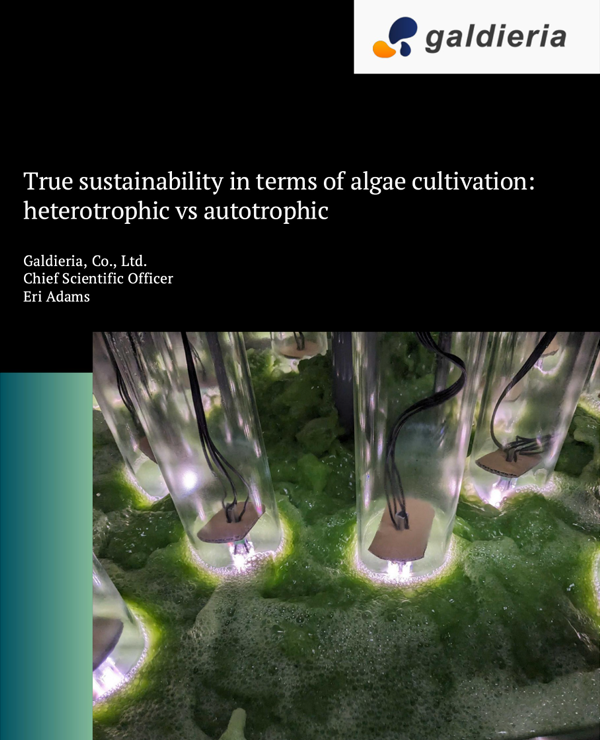
To address this question, we used Galdieria, a thermoacidophilic unicellular red alga capable of autotrophic, mixotrophic, and heterotrophic growth, as a model organism. We investigated the electricity consumption as well as the economic and environmental costs associated with small-scale and large-scale batch cultivation under autotrophic and heterotrophic conditions.
The full paper is available for download (Japanese and English versions).
After submitting the form, a download link will be sent to you.